


India hosts 2,117 GCCs and $98.4 billion in market revenue. The newest centres inherit that scale as a burden. This is why greenfield GCCs lose the war for trust, and the playbook that wins it.
India owns the global capability center story. The numbers read like a coronation: 2,117 centres, $98.4 billion in revenue, 2.36 million professionals, and 506 Forbes Global 2000 firms with an India footprint. The founder of a new center assumes this tide lifts every boat. It does not. The greenfield center inherits the category scale as a shadow, not a shield.
The Startup Stigma Without the Startup Pulls
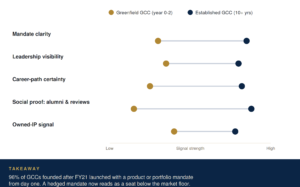
A greenfield GCC asks top-tier talent to wager a career on an entity that lives as a corporate promise, not a proven place. It carries the risk profile of a startup and offers none of the equity, the mission romance, or the founder mythology that pulls talent toward risk. A mature center holds alumni networks, a decade of Glassdoor proof, and a library of stories. The greenfield center holds a logo and a lease.
Compensation does not decide the contest; senior tech pay in India tracks global benchmarks. The candidate weighs trajectory. A senior engineer in Bengaluru, scrolling a review site at midnight, asks one question: will this center own something, or vanish in the next cost review?
The HQ Credibility Gap
The deeper wound is self-inflicted. Parent organisations announce the India center as a “strategic innovation partner,” and route budget authority, roadmap control, and marquee projects back to headquarters. Talent reads the distance between the press release and the org chart inside one interview. A center that cannot name whether it owns a product line, sets architecture, or extends someone else’s backlog forfeits the candidate before the offer stage.
This dissonance carries a cost the market can price. FY26 data shows that 96% of GCCs founded after FY21 launched with a product or portfolio mandate from day one. The crawl-walk-run era is over. A greenfield center that hedges its mandate signals a seat below the new baseline, not a place at the frontier.
EXHIBIT 1
The trust deficit a greenfield GCC starts with
The counter-benchmark: how the credible ones moved
Set the hedgers against Lloyds Technology Centre. Lloyds Banking Group opened its Hyderabad center in November 2023 and refused the back-office frame from the first press line. It bound the center to a multi-billion-pound group transformation and gave it AI, cloud, and engineering mandates at launch. It hired a marquee leader, Sirisha Voruganti, a former first female technology managing director at JP Morgan Chase India, and put its group chief operating officer on record about India as a transformation engine, not a cost lever. The center crossed 500 people in its first phase and held one story across UK and India voices.
The pattern travels beyond one bank. Credible greenfield centers front-load three commitments: a named leader with global authority, a mandate stated in product terms, and a global C-suite that appears in India with a cadence that makes the promise physical.
The playbook: a multi-year brand build, not a hiring sprint
Treat the launch as a brand program measured in years, not a six-month requisition burn. Four moves separate the centers that earn trust.
1. Close the gap in writing. Publish the mandate. Name the products the center owns. Silence invites the worst assumption.
2. Front-load intellectual property. Ship a patent, a platform, or a global release inside year one. Proof beats prose, and one owned outcome converts more skeptics than a quarter of recruitment ads.
3. Make leadership presence physical. A global executive who co-locates in India for weeks converts the back-office whisper into a boardroom fact.
4. Localise the narrative. A global EVP pasted into India reads as generic. Rebuild it around what Indian talent prices: ownership, engineering depth, growth velocity.
EXHIBIT 2
The greenfield trust flywheel
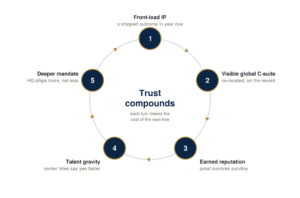
India’s talent depth is a settled matter. The open question sits on the other side of the table. Does the parent hold the patient capital and the strategic nerve to earn trust before it demands loyalty? The centers that grasp this build the employer brands that make them indispensable.
The question was never whether India has the talent for your greenfield GCC. It is whether your organisation has the patience to earn theirs.