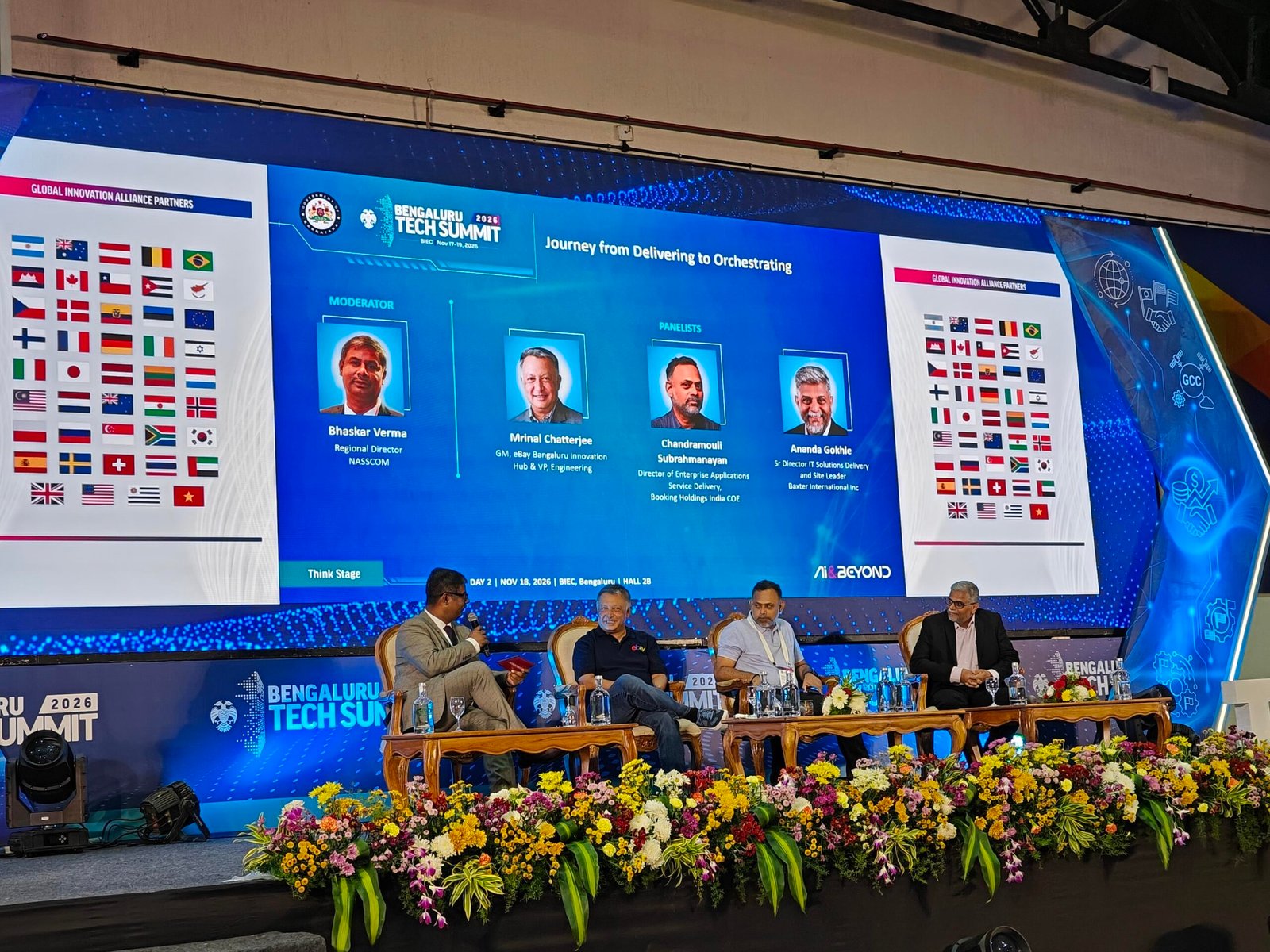

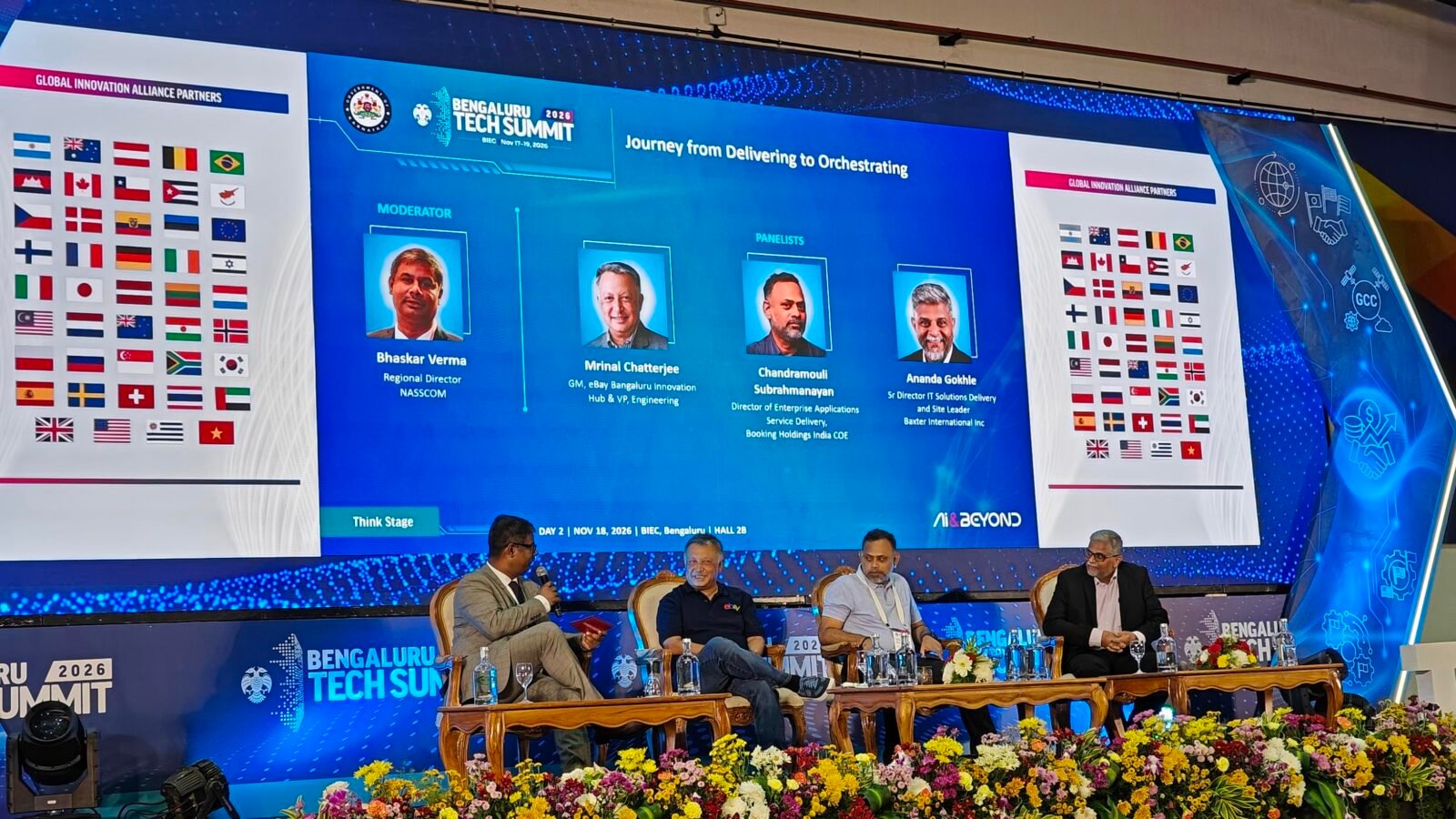
As Global Capability Centres (GCCs) evolve beyond traditional delivery mandates, the conversation is increasingly shifting towards how they contribute to business outcomes, participate in decision-making, and take greater ownership of solutions. At Bengaluru Tech Summit 2026, a panel discussion titled “Journey from Delivering to Orchestrating” explored what this transition means in practice, examining customer understanding, experimentation, collaboration, talent, and the relationship between GCC teams and global leadership.
The discussion brought together Mrinal Chatterjee, GM, eBay Bengaluru Innovation Hub & VP, Engineering, Chandramouli Subrahmanayan, Director of Enterprise Application Service Delivery, Booking Holdings India COE, and Ananda Gokhle, Sr Director IT Solution Delivery and Site Leader, Baxter International, with Bhaskar Verma, Regional Director, NASSCOM, moderating the conversation.
Rather than defining a universal model for GCC evolution, the panel offered examples of how teams are working towards greater business alignment, building trust and demonstrating their capabilities through execution.
Moving Beyond Delivery Towards Business Outcomes
For GCCs seeking a more active role in global business decisions, understanding the problem behind the work is becoming increasingly important. The panel emphasized that delivery alone does not establish strategic value. Teams need to understand the business, the customer, market priorities and the outcomes their work is expected to achieve.
At eBay, this involves connecting engineering work with the experiences of buyers and sellers across its marketplace. Mrinal Chatterjee, GM, eBay Bengaluru Innovation Hub and VP, Engineering, spoke about the centre’s focus on understanding customer and seller challenges, including the complexities of cross-border trade and transactions.
Chatterjee also emphasized the importance of employees being able to explain the business problem their work addresses, rather than simply reporting completed tasks. Understanding the company’s priorities, competition, and customer needs, he noted, helps teams engage more meaningfully with global leadership.
Experimentation as a Way to Demonstrate Capability
The panel highlighted experimentation and proof of concept (PoC) development as practical ways for GCC teams to demonstrate their capabilities and build confidence with business stakeholders.
Chandramouli Subrahmanayan, Director of Enterprise Application Service Delivery, Booking Holdings India COE, shared that an engineer developed a proof of concept for a legal team’s vendor-related process overnight. The prototype helped initiate further conversations with the business about exploring and potentially funding the solution.
Mrinal Chatterjee shared a similar example from eBay Live, the company’s live commerce business, where applied researchers worked on a personalisation challenge and presented a solution within less than a sprint.
These examples illustrate how teams can use experimentation to demonstrate what they can deliver, create opportunities for collaboration and bring business stakeholders into conversations about solutions earlier.
Building Trust Through Business Understanding
The discussion underscored that gaining a greater role in global decision-making requires more than technical capability. It also involves building trust, understanding the priorities of headquarters, and communicating in terms that connect with business objectives.
Mrinal Chatterjee reflected the importance of aligning the team’s vocabulary with the priorities of global leadership. Understanding the wider business context, including market dynamics and competitive priorities, can help GCC teams position their work as a contribution to enterprise objectives rather than as isolated technology deliverables.
The panel also discussed how leadership visits can be used to demonstrate capabilities more directly.
At Booking Holdings, the approach includes conducting what Chandramouli Subrahmanayan described as a “lightning walk”, where visiting leaders are taken through working areas to see prototypes, demonstrations and ideas developed by engineers and product teams.
Rather than relying exclusively on presentations, these demonstrations allow leaders to see the work, interact with the people behind it, and assess how teams are approaching business challenges.
The approach places emphasis on showcasing work in progress, practical solutions, and the capabilities being developed within the centre.
Talent, Growth and the Changing Expectations of Engineers
Talent remains central to the ability of GCCs to expand their responsibilities. The panel discussed retention, career aspirations, autonomy, meaningful work, and the challenge of competing with startups and other organisations for skilled professionals.
Ananda Gokhale, Senior Director, IT Solutions Delivery and Site Leader, Baxter International, spoke about the importance of developing talent internally and leveraging existing organisational capabilities. He also highlighted the connection between employees’ work and the impact of the organisation’s products on people’s lives, as a way of helping teams understand the value of their contributions.
Chandramouli Subrahmanayan emphasised that engineers want to see their work deployed, understand its impact, and have opportunities to grow. He also highlighted the importance of a working environment where employees feel valued and have the confidence to experiment without being afraid of failure.
The discussion reinforced that retaining talent is not only about compensation or hiring strategies. The nature of the work, opportunities for growth, managerial support, and the ability to contribute meaningfully also shape employees’ experience.
From GCC Execution to Greater Enterprise Participation
The discussion at Bengaluru Tech Summit 2026 highlighted how GCCs can deepen their contribution to global enterprises by moving beyond task execution towards greater ownership, grounded in business understanding, experimentation, collaboration and talent development.