

As Global Capability Centres (GCCs) take on greater Product ownership, one question continues to shape their effectiveness: How close are these teams to the customers using the products they build?
Traditionally, customer proximity has often been associated with geography. Product teams located closer to key markets or customer-facing business units are assumed to have an advantage in understanding customer needs.
But geography alone does not guarantee customer understanding. A team sitting in the same market can still be disconnected from customer problems, while a team operating thousands of miles away can have deep customer context through structured engagement, research, and data.
The distinction is becoming increasingly important as GCCs evolve from execution centres into Product and innovation hubs.
Customer Proximity is About Access, Not Geography
Direct customer access varies across GCC Product organisations. Some teams engage with customers regularly, while others depend on global counterparts, research, analytics, and usage data to understand customer behaviour.
The opportunity is to create repeatable mechanisms that bring customer context into everyday Product decisions.
These mechanisms can take several forms:
| Customer Connection Mechanism | What it Helps Product Teams Understand |
|---|---|
| Customer interviews and research | Customer needs, expectations and unmet requirements |
| Market immersion | Market dynamics, competitive positioning and emerging trends |
| Sales and pre-sales exposure | Buying behaviour, customer objections and business priorities |
| Product usage analytics | Adoption patterns, feature usage and points of friction |
| Customer support data | Recurring issues, pain points and product gaps |
| Competitive intelligence | Competitor capabilities and changing customer expectations |
Together, these inputs help Product teams move beyond interpreting requirements to understanding the underlying problems those requirements are intended to solve.
Connecting Customer Insight to Product Decisions
Biju Davis, SVP & Site Leader, InvoiceCloud, captures this distinction well:
“The focus is less about the closest location and more about how close the product team can stay to the customer problem.”
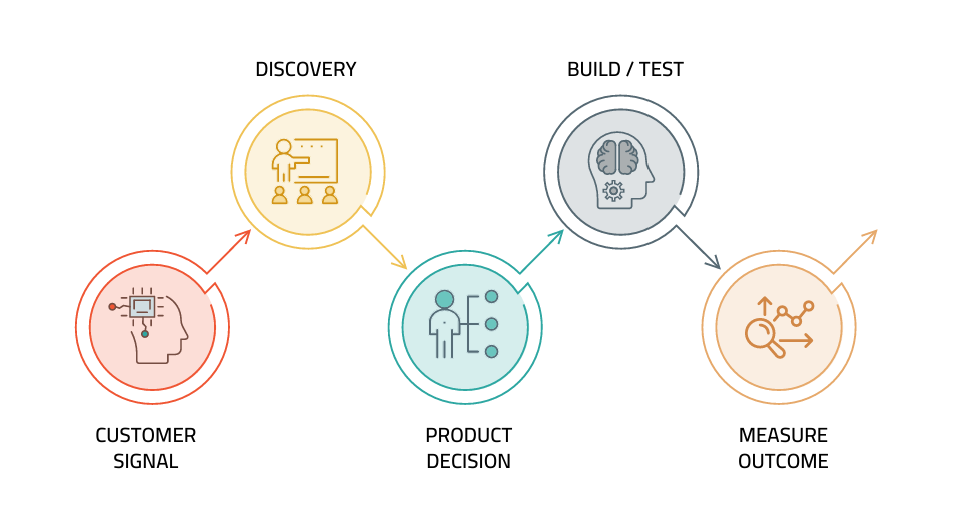
This is an important consideration for GCC leaders. Access to customer information is only one part of the equation. Teams must also have the ability to translate those insights into discovery, prioritisation, roadmap decisions, and measurable outcomes.
Customer insight without decision authority creates frustration. Equally, decision authority without customer context creates risk.
Strong Product operating models bring both together.
Building Customer Context into the GCC Operating Model
For GCC leaders, the starting point is to move customer engagement from an occasional activity to an integral part of the Product lifecycle. This means creating structured access to customers, involving Product teams in market and business conversations, and ensuring that customer signals influence prioritisation and success metrics.
The objective is not necessarily to relocate Product teams closer to customers. It is to remove the barriers that prevent them from understanding and responding to customer needs.
The strength of a GCC Product organisation will not be determined by how close it sits to the customer geographically, but by how effectively it understands the customer problem and shapes the solution.
This article is part of GCC Pulse’s Function Deep Dive series on Product in GCCs.
Explore the full report
How are GCC Product organisations evolving from execution support towards greater influence and ownership?
Our latest report, Inside Product in GCCs: Who Builds, Who Decides, Who Owns? explores decision rights, customer proximity, business impact, Product talent, and AI, concluding with a practical seven-point playbook for GCC leaders.
Download the full report to explore the research, leadership perspectives, and actions for building greater Product authority within GCCs.
Photo by CHUTTERSNAP on Unsplash