


By 2030, AI adoption is outpacing the ability of education and training systems to keep up. Programs remain focused on traditional roles, while organizations increasingly rely on automation instead of investing in human capability. High-volume jobs in finance, operations, and HR are disappearing first, leaving workers struggling to adapt to AI-native workflows.
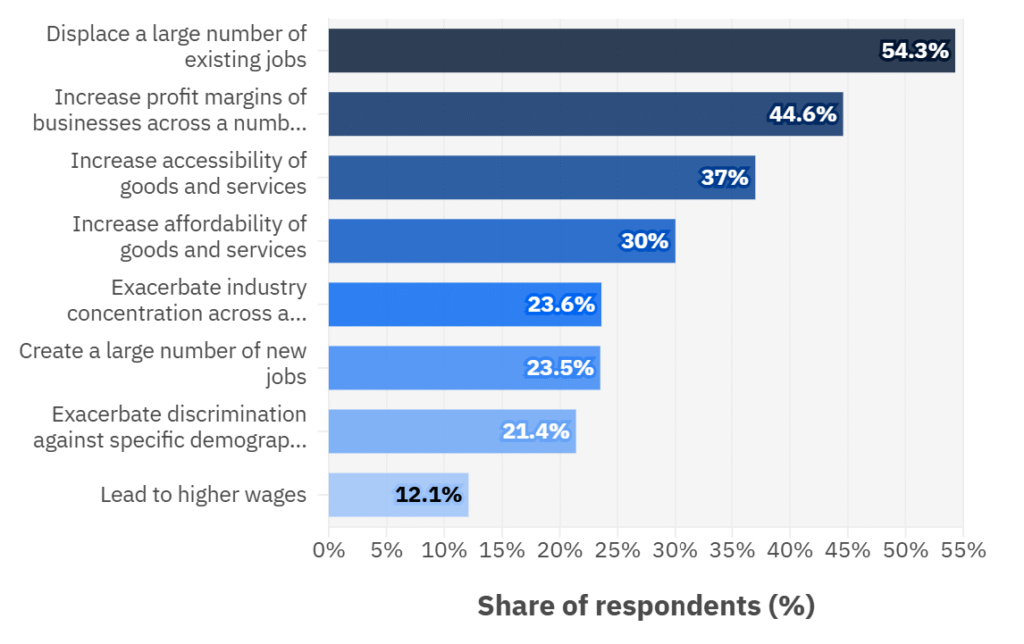
New AI-complementary roles do appear, but most displaced employees cannot acquire the skills quickly enough. Labor mobility slows as the gap between talent supply and demand widens. Large sectors that once scaled human talent efficiently now reveal the limits of workforce systems. Their standardized operations make them particularly vulnerable to early automation, turning skill gaps into structural displacement.
Key challenges in workforce adaptation:
- Education and training programs are slow, outdated, and misaligned with emerging AI-driven needs
- Adaptive and cross-functional skills are scarce, leaving workers unprepared for dynamic roles
- Even large global labor pools like those in GCCs cannot offset the disappearance of standardized roles
- The mismatch between AI-driven demand and workforce capability signals a broader societal challenge
- Countries and organizations that fail to reskill their workforce risk widening inequality, weakening economic resilience, and creating persistent gaps between talent supply and labor market needs
When Jobs Hollow Out: AI Takes the Lead
AI now performs more than half of the tasks in many workplaces and handles nearly all operational work in high-exposure industries. Some organizations allow AI agents to make decisions with minimal human oversight, accelerating role hollowing.
Even human-centric roles such as gig work, customer service, or creative positions cannot absorb the flood of displaced workers. Automation continues to encroach on these positions, reducing opportunities for labor mobility. Sectors like GCCs feel this pressure first because high-volume, process-driven functions are automated rapidly, providing an early view of what the broader workforce will face.
AI-driven job dynamics:
- Tasks are automated faster than workers can be reskilled
- Emerging roles often require specialized skills beyond the reach of most displaced employees
- Human decision-making is increasingly outsourced to algorithmic systems
The hollowing out of roles has ripple effects across organizations. When humans are removed from core processes, knowledge transfer slows, leadership pipelines shrink, and the human capacity to adapt to future disruptions is weakened.
Decoding Displacement: Our Take on AI Acceleration and Workforce Limits
Sectors like GCCs, startups, and tech companies provide a front-row view of how AI is reshaping work. Their standardized operations make them the first to experience large-scale automation, revealing structural vulnerabilities in talent systems.
From our perspective:
- Human capability must evolve as quickly as technology to prevent structural displacement
- Sectors like GCCs provide early signals for where skills, reskilling, and adaptive learning are most urgently needed
- Investing in cross-functional and AI-complementary skills is essential to maintain human-centered work
The Future of Work: Redefining Employment
Scenario 2 ‘Age of Displacement’ warns that productivity gains from AI come with social and economic pressures. Unemployment rises, labor mobility declines, and inequality deepens.
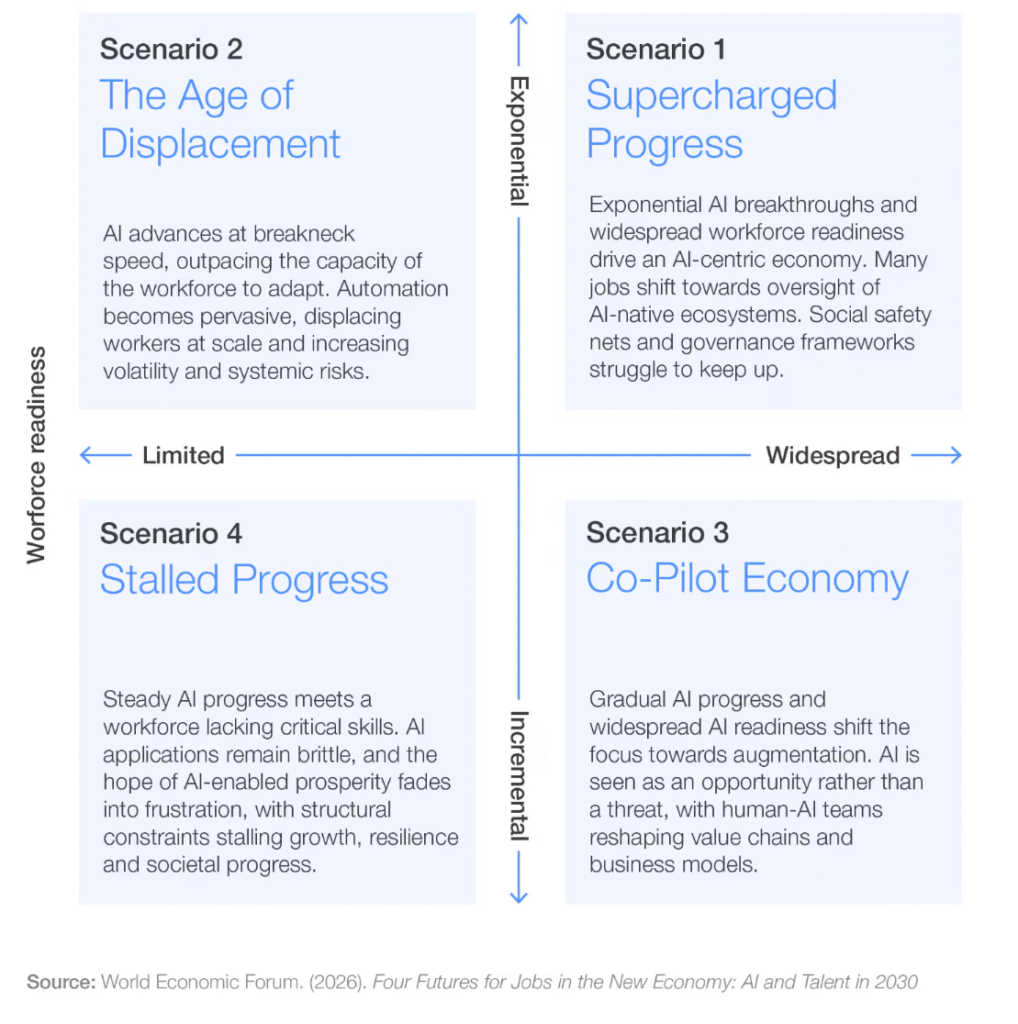
By 2030, displacement will be structural rather than temporary. The future of work depends on whether governments, businesses, and educators can rebuild human capability fast enough to keep pace with AI, ensuring work remains human-centered rather than defined by structural exclusion. Without proactive intervention, automation may accelerate productivity while leaving large portions of the workforce marginalized.
Analysis and interpretation based on Four Futures for Jobs in the New Economy: AI and Talent in 2030 by Word Economic Forum.