Founded in 1975, Vanguard is one of the world’s largest investment management firms, managing over $12.5 trillion in assets and serving more than 50 million investors globally.
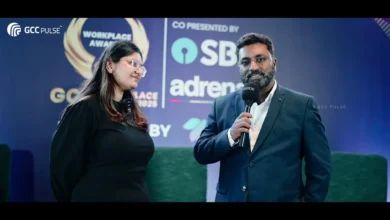
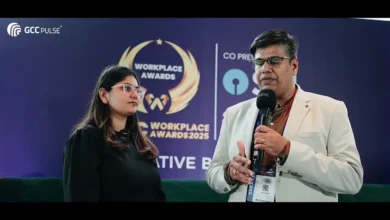
During our visit to its Hyderabad office, we met with Nitin Tandon, the firm’s Chief Information Officer overseeing global technology strategy, and Jon Couture, Chief Human Resources Officer responsible for talent, leadership, and culture across Vanguard’s worldwide operations.

In November 2025, Vanguard added a new chapter to that journey with the launch of its operations in Hyderabad, India.
A New GCC, Already in Motion
The atmosphere at the Hyderabad office was anything but tentative. The space was active. Leaders from global teams, media interactions, and internal discussions in full flow. For a center that is just a few months old, it carried the rhythm of an organization that had already found its footing.
This did not seem to be a typical offshore setup in its early stages. Vanguard’s ‘India office’ has been positioned as a long-term, integral part of its global operating model from the outset. The focus areas—AI/ML, data and analytics, cloud engineering, cybersecurity, and others are aligned directly with the firm’s digital priorities.
The company currently operates out of a temporary facility in Hyderabad’s Sattva Knowledge Park, with plans to move into a larger, permanent campus at Image Towers by 2027.
Scaling With Intent
The numbers seemed to indicate steady, controlled growth. The India team currently stands at around 500+ employees, with plans to double to approximately 1,000 by the end of the year. Over the next three years, Vanguard expects the workforce to scale to over 2,300.
Nitin and Jon repeatedly highlight a focus on maintaining talent quality even as hiring accelerates. Hyderabad, in this context, is seen as a strategic talent market offering depth in engineering, data, and product capabilities, alongside a relatively high quality of life.
A Globally Distributed Model
Vanguard’s India expansion is part of a broader global footprint that includes a handful of similar strategic hubs across key markets such as the United States, London, and Toronto. These centers operate as interconnected nodes rather than isolated delivery units, enabling the firm to distribute capability while maintaining consistency in execution.
The Hyderabad center is being designed along the same lines. Fully integrated into this global network, with clear ownership and accountability across functions.
“An India Office, Not an Offshore Arm”
A recurring theme in conversations with Nitin and Jon is the positioning of the India Center.
There is a conscious effort to avoid the traditional offshore narrative.
Instead, the Hyderabad setup is being built as an “India office” with end-to-end ownership across functions. Product owners, UX leaders, and engineering heads are part of the local ecosystem, working in close alignment with global teams across geographies.
The structure reflects a broader shift in how Global Capability Centers (GCCs) are being designed—moving from execution-focused units to integrated hubs with direct accountability.
Technology, With Guardrails
Technology sits at the core of Vanguard’s strategy, but the approach to emerging technologies like AI remains measured.
According to Nitin, the firm has been using AI and machine learning for over a decade, well before the current wave of generative AI adoption. However, the emphasis today is as much on governance as it is on innovation.
“Trust is the biggest currency,” Nitin noted during the interaction, particularly relevant in financial services, where model inaccuracies or biases can have direct implications for investors.
To manage these risks, Vanguard has implemented internal evaluation frameworks for AI models. One such mechanism, referred to as the “Vanguard Bench” or an internal “LLM jury,” is designed to rigorously evaluate the efficiency and veracity of AI outputs before they are deployed at scale.
Building Culture Alongside Capability
For Jon, the India expansion is as much a cultural build as it is a technological one.
The company is focusing on hiring individuals who can operate effectively in a globally distributed environment, with an emphasis on what leaders describe as “cultural synergy.” Structured overlap hours and collaborative workflows are being designed to ensure seamless integration with teams across geographies.
At the same time, Vanguard is experimenting with AI-led tools internally, including coaching solutions aimed at supporting managers in leadership development and other areas.
An Ecosystem Approach
Vanguard’s India strategy also reflects a broader ecosystem mindset.
The firm continues to work closely with global sourcing partners, viewing them as long-term collaborators. In parallel, there is early engagement with the local startup and innovation ecosystem, including partnerships across the ecosystem. This dual approach, leveraging global partnerships while embedding locally, suggests a calibrated expansion model.
The Long View
For now, Vanguard’s immediate focus in India remains execution—building teams, stabilizing operations, and embedding core capabilities. Investments in areas such as cybersecurity, fraud prevention, and cloud infrastructure are already underway, aligned with the firm’s broader digital transformation goals.
In an environment where many global firms are rethinking the role of their India centers, Vanguard’s Hyderabad hub appears to be designed as a strategic extension of the enterprise.
Note: This article is based on a media interaction organized by Vanguard.