

Every week, a board approves another Global Capability Centre in India. The deck’s slide one says India is cheaper. Slide two celebrates the engineering talent. The third slide projects the savings. None of the three slides explain why ‘India keeps winning’. It is because the world’s most important engineering decisions cannot be made without Indian talent. The ecosystem is still describing that shift in the vocabulary of cost cuts, and that vocabulary is now the thing holding it back.
The Myth
Every mature industry eventually gets trapped by the language that made it successful. Manufacturing had cheap labour. Software had offshoring. India’s GCC still have cost arbitrage. None of these phrases survive success, and India’s GCC ecosystem has succeeded past the point where its own pitch still makes sense.
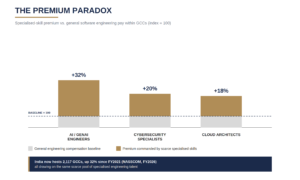
India now hosts 2,117 Global Capability Centres, up 32 percent since FY2021. AI, GenAI and other specialised engineering skills already command 20 to 32 percent above general software engineering pay inside these centres, and GCCs are on track to hand out salary increments of roughly 11.5 percent in 2026, well ahead of India Inc’s broader average of 9.1 percent. A location that has to outbid its own domestic market for talent is not running a discount play.
None of this makes the arbitrage era a mistake. It was extraordinarily successful. It created millions of high-value jobs, attracted global capital, and built engineering ecosystems that did not exist thirty years ago. The mistake is believing that yesterday’s advantage should remain tomorrow’s identity.
The Contradiction
A senior AI or platform engineer inside a Bengaluru GCC now costs meaningfully more than a general software engineer at the same level, the opposite of what the arbitrage pitch implies. Enterprises are still sold a discount narrative for a workforce whose scarcest skills price like a seller’s market. The gap is where the ecosystem’s credibility is leaking out.
There is a second cost the arbitrage frame never counts: distance. When the architectural decisions sit in Silicon Valley or Geneva, and the execution sits in India, the friction of hand-off and the rework created by misaligned context erode whatever savings the cost model promised. The savings were never really about cost. They were about proximity to decisions the ecosystem was never invited into.
The Missing Metric
Every economy eventually needs something that holds its value after the currency of the moment is spent. Cost savings are borrowed growth: useful, but repayable, and always owed back to whoever holds the architecture. Patents and retained IP are the foreign exchange reserves of an innovation economy. Architectural authority is the monetary policy that decides how those reserves get spent.
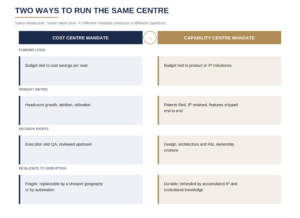
The test is simple. If 70 percent of a product’s global engineering headcount sits in an Indian hub, does the chief architect sit there too, and does the hub carry profit and loss accountability for the product, or only delivery accountability for the parts of it built there? Where the honest answer is delivery accountability alone, the centre is still running someone else’s monetary policy.
The New Currency
India’s greatest competitive advantage may be that it has become too expensive to qualify as a low-cost destination anymore. Every ecosystem that has made this transition passed through the same three stages: cheap labour, then execution excellence, then decision sovereignty. South Korea and Israel are the clearest precedents.
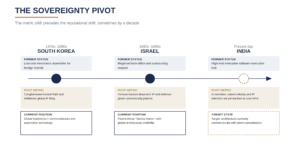
Neither South Korea nor Israel waited to be seen differently before they changed what they measured. The metric shift came first. The reputational shift followed, sometimes by a decade. India does not need permission from global boardrooms to start tracking patent velocity and IP retention. It needs the discipline to start reporting them.
Renegotiate the mandate at every hiring cycle, not after it, trading headcount growth for a specific decision right. Report IP retention and patent velocity as board-level KPIs alongside headcount and attrition. Concentrate capital in two or three genuinely specialised domains per hub instead of spreading it across generic capacity. Policymakers can do their part by shortening patent examination timelines and tying tax incentives to the commercialisation of domestically registered IP, so owning it onshore is the rational choice.
The first generation of India’s GCC story proved the country could build the world’s products. The second must prove it can own the ideas behind them.