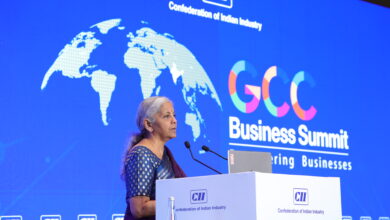


Union Budget 2026 may not have unveiled a sweeping national policy dedicated to Global Capability Centres (GCCs), but it has made a clear and deliberate intervention where the ecosystem needed it most: predictability. At a time when global enterprises are reassessing location strategies and operating models, the Budget strengthens India’s positioning as a stable and scalable base for global capability.
Predictability as a Strategic Enabler
For GCC leaders, policy certainty is no longer a narrow compliance concern; it is a strategic determinant of mandate depth and long-term relevance. As Pari Natarajan, CEO of Zinnov, notes:
For GCC leaders, predictability on tax outcomes is not just a compliance issue; it determines whether higher-value global mandates in AI, engineering, and core business functions can be confidently anchored in India. When this certainty is combined with incentives for global cloud infrastructure and a sustained push on AI capability and talent development, the Budget creates an environment where GCCs can move beyond cost efficiency to becoming true engines of enterprise innovation.
This perspective underscores why Budget 2026 matters beyond its technical provisions. By addressing long-standing uncertainty, the Budget creates conditions for GCCs to evolve from execution centres into platforms for enterprise innovation and decision-making.
A Structural Reset for Transfer Pricing Certainty
Transfer pricing has historically been one of the most persistent sources of friction for GCCs operating in India. Leadership bandwidth has been consumed by audits, notices, and prolonged litigation across forums such as the TPO, DRP, and ITAT—often at the expense of strategic growth.
Budget 2026 tackles this challenge through a set of pragmatic, system-level reforms. Software development services, IT-enabled services, KPO, and contract R&D have now been consolidated under a single category—Information Technology Services. A uniform safe harbour margin of 15.5% applies across this category, with the eligibility threshold expanded sharply from ₹300 crore to ₹2,000 crore.
Equally significant is the move to automated, rule-driven safe harbour approvals, removing discretionary intervention. Companies can now opt into the regime for up to five consecutive years, enabling multi-year planning with far greater confidence. Fast-track unilateral Advance Pricing Agreements (APAs) further reinforce this shift toward efficiency and certainty.
Hitesh Thakral, Head of Finance at Wayfair India, observes:
The proposal of a single safe harbour margin of 15.5% for all covered IT and IT-enabled services (coupled with automated approvals) is a very welcome move. It should go a long way in rationalising and standardising margins used by GCCs while billing their overseas parent companies.
Momentum Today, Expectations for Tomorrow
Collectively, these measures reduce compliance friction and improve India’s attractiveness for both existing GCCs and new entrants. They also align with the government’s broader ease-of-doing-business narrative.
That said, Budget 2026 remains more tactical than transformational. The ecosystem will now look ahead to deeper regulatory clarity, stronger Centre–State alignment, and a formal national GCC framework that recognises GCCs as strategic economic infrastructure.
Our PoV
The foundation is stronger. The direction is clear. What the industry now awaits is the next chapter where execution-led reforms evolve into a coherent, long-term GCC policy vision.
Disclaimer: The views expressed in this article are those of the author/editorial team and do not necessarily reflect the views of quoted individuals or their organisations.